

Quick Summary
Professional event lighting is worth it when a venue looks flat or the room will appear in photos, video, or brand moments. For small, short gatherings in well-lit spaces, DIY lighting can be enough. Most value comes from even wall coverage, controlled color, and a planned cue timeline.
- Professional lighting is usually worth it above about 100 guests or when the room is the photo backdrop.
- Uplighting along walls is the most cost-effective upgrade for most reception rooms.
- Labor is usually the largest variable cost in a professional lighting quote.
- Ask providers to itemize design, labor, power, and rigging before comparing totals.
- Confirm venue power circuits and rigging rules before finalizing a lighting design.
Table of Contents
- What Professional Event Lighting Actually Changes
- DIY vs. Professional Event Lighting: Where the Real Differences Are
- How Professional Event Lighting Cost Is Built Up
- Event Lighting Packages and What They Typically Include
- Wedding Reception Uplighting Ideas That Earn Their Place
- Safety, Venue Rules and Technical Risk to Plan For
- Deciding Whether Your Event Needs Professional Lighting
- Frequently Asked Questions
Is Professional Event Lighting Worth the Cost?
Last Updated: November 2, 2026
What Professional Event Lighting Actually Changes
Professional event lighting is worth it when your venue looks flat and your guests need to feel the room shift. A space that looks ordinary under overhead fixtures can feel finished once the lighting is planned around the room, the timeline, and the music.
Lighting does three jobs at once: it shapes atmosphere, controls what guests see, and determines how photos and videos turn out. Most venues use general house lighting designed for function, not mood. Professional lighting replaces that with layers: wash light on walls, accent light on tables or décor, and color or movement on the dance floor. Because those layers need to work together as the event changes, professional lighting software can help coordinate cues that shift the room from dinner to dancing.
Lighting also changes how long guests stay engaged. Warm, controlled light encourages people to linger, talk, and move toward the dance floor; harsh or uneven light feels like a conference break.
DIY vs. Professional Event Lighting: Where the Real Differences Are
DIY lighting can work well for small gatherings. A few clip-on lights, string lights, and a basic battery uplight may cover a backyard party with 20 guests.
The real differences show up in four areas:
- Coverage: Professional fixtures are placed to wash entire walls and columns evenly. DIY setups often leave dark corners and hot spots.
- Control: A lighting operator can adjust color, intensity, and timing to match speeches, toasts, and first dances. DIY lights usually run on one setting all night.
- Setup and teardown: Amateur setups often lose time to troubleshooting during load-in.
A common mistake is treating lighting as a purchase instead of a plan. Buying twelve fixtures does not give you a designed room. The fixture placement, angles, and color choices matter more than the quantity.
How Professional Event Lighting Cost Is Built Up
Most articles about event lighting value stop at “it depends on your event.” More useful is understanding how a lighting quote is assembled, what each line item buys, and how a DIY budget accumulates hidden costs, so you can compare apples to apples.
A professional lighting quote is usually built from five components. Ask any provider to break out the quote along these lines so you can see where the money goes.
- Design and consultation: A site walkthrough, lighting plot, fixture placement, color palette, and cue planning, the intellectual work that separates a designed room from a pile of rented fixtures. Some providers fold it into the package; others bill it separately.
- Equipment rental: Fixtures, wireless uplights, cable, power distribution, rigging hardware, and control gear, typically priced per fixture per day with reduced additional-day rates. Fixture count is driven by wall and column coverage, not dance floor size alone.
- Labor: Load-in, setup, programming, operation, and teardown. Usually the largest variable, scaling with crew size, venue access difficulty, and event length. A room with a freight elevator and loading dock costs less to staff than a third-floor walk-up.
What DIY lighting actually costs
DIY looks cheaper because the visible cost is the fixture. The real cost is the sum of everything the professional quote bundles:
- Fixtures and controllers purchased or rented, often at retail or single-day rates higher per unit than a package rate
- Cables, extension cords, power strips, gaffer tape, and safety ramps
- The time of whoever designs, hauls, sets up, operates, and tears down the system, usually the host, a friend, or a planner needed elsewhere
Questions that make quotes comparable
When you collect quotes, ask each provider the same set of questions so the numbers line up:
- How many fixtures, and what type, are included for my room size and layout?
- Is design and programming included, or billed separately?
- How many labor hours are quoted for load-in, operation, and teardown?
Watch out: a quote that lists only a package price and a fixture count is not comparable to one that itemizes labor, power, and design. Ask for the breakdown before you compare totals, and confirm whether taxes, travel, and venue fees are included.
The table below breaks down what a professional lighting quote typically covers, so you can compare providers line by line.
| Cost component | What it covers | Note |
|---|---|---|
| Design and consultation | Site walkthrough, lighting plot, color palette, cue planning | Sometimes bundled, sometimes billed separately |
| Equipment rental | Fixtures, wireless uplights, cable, power, rigging, control gear | Priced per fixture per day |
| Labor | Load-in, setup, programming, operation, teardown | Usually the largest variable cost |
| Power and rigging | Distro, cable ramps, truss, venue-required safety hardware | Often missing from DIY budgets |
| Contingency and operations | Spare fixture, on-site contact, cue coordination | Backup gear reduces mid-event failure risk |
Event Lighting Packages and What They Typically Include
Lighting is sometimes sold as a package rather than à la carte. Packages can cover uplighting, accent fixtures, dance floor lighting, and sometimes monogram projection or an operator.
Packages can save planning time, but only make sense if the included items match your room. Before you book, confirm which fixtures are included, how many hours the operator stays on site, and what happens if the venue restricts a particular setup. You can review the lighting service and what it includes on the Lighting page.
Wedding Reception Uplighting Ideas That Earn Their Place
Uplighting is the most cost-effective upgrade for most reception rooms. Placed along walls or behind draped chairs, wireless uplights wash the room in color, hide plain surfaces, and photograph well.
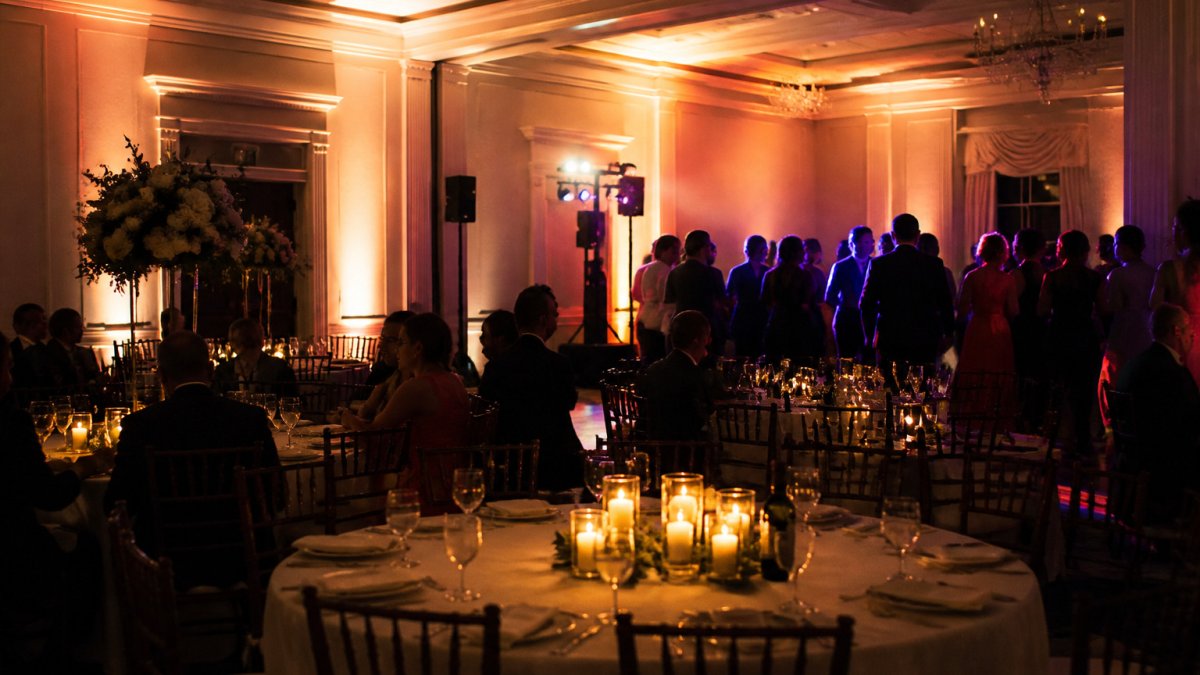
Three uses tend to earn their cost:
- Perimeter wash: Light the walls in a single warm tone to make the room feel larger and more intimate.
- Monogram or pattern projection: A couple’s monogram on the dance floor or a wall ties the room to the event’s theme.
- Dance floor accents: Moving or colored light near the dance floor signals that the party has started.
Avoid overloading the room with too many colors, a consistent palette looks more deliberate than a rainbow, and photographers appreciate cleaner backgrounds. If you are coordinating lighting with the DJ and timeline, plan cues in advance so the lights shift with announcements and the first dance.
Safety, Venue Rules and Technical Risk to Plan For
Lighting carries technical and safety risks that deserve early attention. Venues often have rules about rigging, open flames, cable placement, and load limits, and some prohibit anything attached to walls or ceilings.
Watch out: a lighting design that looks good in a walkthrough can fail if the venue’s circuits cannot carry the load.
Other planning points include:
- Clear cable runs to prevent trips, especially near dance floors and buffet lines
- Backup fixtures or a spare power option in case of equipment failure
- A named contact on the day who can troubleshoot sync problems between lighting and music
For events where lighting, music, and the photo booth share one timeline, a single coordinating team helps keep the room, timeline, and dance floor connected.
Deciding Whether Your Event Needs Professional Lighting
The five-question checklist most articles offer does not tell you what kind of lighting your event needs or how to measure whether the spend paid off. A more useful approach is a short decision framework built on four inputs, event size, venue, schedule, and visual goals, plus a clear-eyed look at the outcomes lighting should produce.
A four-input decision framework
Work through these in order. Each answer narrows the recommendation.
- Event size and guest count. Under about 50 guests in a well-lit room, DIY string lights and a few battery uplights can carry the atmosphere. Above roughly 100 guests, or any event where the room is the main photo backdrop, uneven coverage becomes visible and a designed system earns its cost.
- Venue. A room with large windows, warm house lighting, and architectural detail needs less help. A windowless banquet hall, tent, warehouse, or hotel ballroom with flat fluorescent overheads almost always needs professional layers, wall wash, accent, and dance floor, to avoid looking like a conference break.
- Schedule. A two-hour cocktail reception needs far less than a full day with ceremony, cocktail hour, dinner, toasts, and dancing. The longer the timeline and the more cue changes, the more an operator and programmable system matter.
- Visual goals. If the event is photographed or filmed, if the brand palette must stay consistent across a corporate program, or if the room must transform between segments, professional lighting moves from nice-to-have to necessary.
Event-specific recommendations
- Wedding receptions: Perimeter uplighting in a single warm tone, accent light on the head table and cake, and dance floor lighting with an operator for the first dance and open dancing. Monogram projection is optional and best used on one surface.
- Corporate events and conferences: Stage and speaker visibility first, then brand-color wash on walls and step-and-repeat backdrops. Camera-facing lighting matters because presentations are often recorded or streamed.
- Galas and fundraisers: Layered wash and accent to make silent auction tables and decor readable, with cue changes tied to program segments and appeals.
Measuring whether it was worth it
Lighting value is easier to judge after the event than before. Look for these outcomes:
- Photo and video quality: Even wall wash and controlled color reduce dark corners and color casts, cutting editing time and improving the final gallery.
- Presentation visibility: For corporate programs, readable slides and well-lit speakers translate directly into audience attention and usable recorded content.
- Brand consistency: Color-matched wash and backdrops keep sponsor and brand colors accurate across the room and on camera.
If you answered the four inputs and still are not sure, the tiebreaker is simple: if the room will appear in photos, on camera, or as the backdrop for a brand moment, professional lighting is likely worth it. If the event is small, short, and held in a space with good natural or architectural light, DIY can be the right call. For a quote based on your venue and date, contact Rakis Productions directly through the website contact form.
Frequently Asked Questions
Is professional event lighting worth the cost?
It is worth the cost when lighting affects outcomes you care about: how the room looks in photos and video, whether speakers and performers are easy to see, and whether the space feels finished rather than flat. For a small gathering in a well-lit venue, a few borrowed fixtures may be enough. For a reception in a dark room, a corporate event where a stage must read clearly, or any event where the photos matter, professional lighting usually pays off. Compare the quote against the specific problems you need solved, not against a generic idea of elegance.
How much does professional event lighting cost?
Pricing depends on the number of fixtures, the length of the event, setup and teardown labor, the venue’s power and load-in conditions, and whether a designer is included. Rakis Productions does not publish fixed rates in this article, so pricing depends on quantity, dates and delivery. For current pricing or a quote tailored to your event, contact Rakis Productions directly through the website contact form.
Can DIY lighting work for a wedding reception?
DIY lighting can work for a small reception in a room that already has good ambient light, especially if you use a limited number of uplights and keep the layout simple. It becomes harder when the room is large or dark, when you need to aim fixtures precisely at walls or the dance floor, or when cables must be routed safely through guest areas. Test the setup in the actual room before the event, and confirm with the venue what electrical and rigging rules apply.
What does a professional event lighting package include?
Packages commonly bundle uplighting, dance floor or moving head fixtures, a controller, setup and teardown, and a planning conversation about placement. Some providers also coordinate lighting with the DJ or timeline so cues line up with announcements and first dances. Ask each provider to list the fixture count, the hours covered, what happens if power is limited, and who is on site during the event so you can compare packages on the same terms.

